Sales Tax Nexus 2025: E-commerce Compliance & Financial Impact

Understanding and managing sales tax nexus in 2025 is crucial for e-commerce businesses to ensure multi-state compliance and mitigate significant financial risks, requiring proactive strategies and robust technological solutions.
For e-commerce businesses, the landscape of taxation is constantly evolving. In 2025, navigating sales tax nexus 2025 presents a significant challenge, demanding a proactive and informed approach to multi-state compliance. Ignoring these evolving regulations can lead to substantial financial penalties and operational disruptions, making a clear understanding of nexus critical for sustained growth.
Understanding sales tax nexus fundamentals in 2025
Sales tax nexus is the legal connection between a seller and a state that requires the seller to collect and remit sales tax. This concept, once primarily tied to physical presence, has broadened significantly, especially for e-commerce. The 2018 South Dakota v. Wayfair Supreme Court decision fundamentally reshaped this understanding, introducing economic nexus as a primary trigger.
In 2025, businesses must recognize that nexus can be established in numerous ways, extending beyond traditional brick-and-mortar stores. This complexity necessitates a thorough review of operations and sales activities to identify all potential nexus-creating activities. States are increasingly aggressive in enforcing these rules, driven by the desire to capture revenue from online sales.
Key types of sales tax nexus
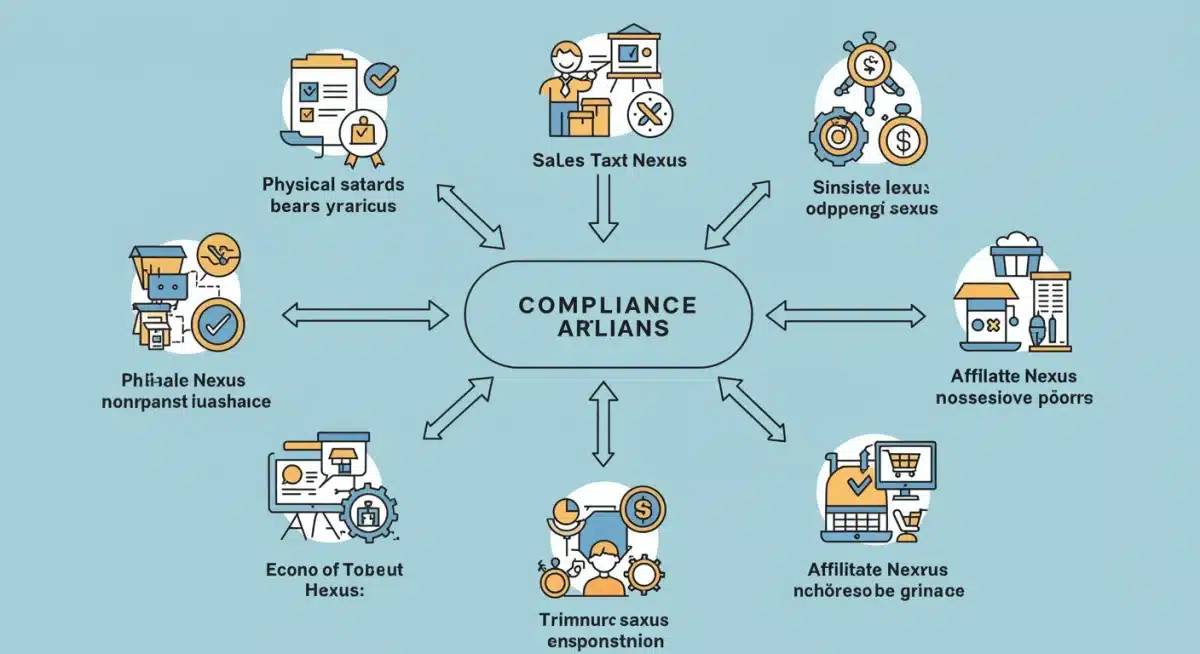
Several types of nexus can trigger a sales tax collection obligation. Understanding each category is essential for comprehensive compliance planning.
- Physical Nexus: This is the most traditional form, established by having a physical presence in a state, such as an office, warehouse, retail store, or even employees working remotely.
- Economic Nexus: Triggered when a business meets certain thresholds for sales revenue or transaction volume into a state, regardless of physical presence. These thresholds vary significantly by state.
- Affiliate Nexus: Created when a business has in-state affiliates who promote their products, even if the primary business has no physical presence.
- Click-Through Nexus: Arises from agreements with in-state residents who refer customers to the seller’s website for a commission.
- Inventory Nexus: Established by storing inventory in a state, often through third-party logistics (3PL) providers or fulfillment centers like those used by Amazon FBA.
Each type of nexus carries its own set of implications for businesses. The challenge lies in monitoring these various triggers across multiple states simultaneously. Failing to do so can result in uncollected taxes, penalties, and interest, which can severely impact profitability. Businesses should regularly assess their activities against state-specific nexus laws to ensure ongoing compliance.
The evolving landscape of economic nexus thresholds
The concept of economic nexus, born from the Wayfair decision, continues to evolve, making it a critical component of sales tax nexus 2025 compliance. Each state has the authority to set its own thresholds, leading to a patchwork of regulations that e-commerce businesses must meticulously track. These thresholds are typically based on gross sales or the number of transactions within a calendar year.
For instance, many states set their economic nexus threshold at $100,000 in gross sales or 200 separate transactions. However, some states have eliminated the transaction count threshold, focusing solely on sales volume. Other states have higher or lower sales thresholds, creating a complex web of requirements. This variability means that a business might establish nexus in one state with relatively low sales, while needing significantly higher sales to trigger nexus in another.
Monitoring state-specific requirements
Staying informed about each state’s specific economic nexus thresholds is paramount. These rules are not static; states periodically review and adjust them, influenced by legislative changes and economic conditions. Relying on outdated information can expose businesses to compliance risks.
- Regularly consult state tax authority websites for updates.
- Utilize tax compliance software that automates threshold monitoring.
- Engage with tax professionals specializing in multi-state sales tax.
- Document all sales into each state to easily assess threshold attainment.
Proactive monitoring allows businesses to anticipate when they might cross a nexus threshold in a new state. This foresight provides time to register with the state, configure sales tax collection, and avoid a retroactive tax liability. The financial impact of missing these triggers can be substantial, including back taxes, penalties, and interest on uncollected sales.
Practical solutions for multi-state compliance
Achieving and maintaining multi-state sales tax compliance in 2025 requires more than just awareness; it demands practical, actionable solutions. E-commerce businesses, regardless of size, need robust systems to manage the complexities of varying tax rates, product taxability rules, and reporting requirements across numerous jurisdictions. The right tools and strategies can transform a daunting task into a manageable process.
One of the most effective solutions is the implementation of specialized sales tax compliance software. These platforms are designed to automate many of the manual processes involved in sales tax, from real-time rate calculation to filing and remittance. They integrate with e-commerce platforms, ensuring that the correct tax is applied at the point of sale, thereby minimizing errors and reducing the administrative burden.
Leveraging technology for compliance
Modern sales tax software offers a suite of features crucial for e-commerce businesses navigating sales tax nexus 2025. These tools can significantly streamline compliance efforts.
- Automated Rate Calculation: Instantly determines the correct sales tax rate based on the customer’s location and product taxability rules.
- Nexus Tracking: Monitors sales volume and transaction counts to alert businesses when they approach or cross economic nexus thresholds in new states.
- Exemption Certificate Management: Helps manage and store exemption certificates for tax-exempt sales, crucial for audit defense.
- Filing and Remittance: Automates the preparation and submission of sales tax returns to various state tax authorities.
Beyond technology, establishing clear internal processes is vital. This includes regularly reviewing sales data, documenting nexus determinations, and ensuring that all sales channels are configured for accurate tax collection. Training staff on sales tax procedures also plays a significant role in preventing errors. By combining technology with sound internal practices, businesses can build a resilient compliance framework.
Financial implications of non-compliance
The financial ramifications of failing to comply with sales tax nexus laws can be severe, extending far beyond simply paying overdue taxes. For e-commerce businesses, non-compliance can lead to a cascade of negative consequences that impact profitability, reputation, and even long-term viability. Understanding these potential costs is a powerful motivator for prioritizing compliance in 2025.
States are increasingly aggressive in auditing businesses for sales tax compliance, particularly those with a significant online presence. When an audit reveals uncollected sales tax, businesses are typically held responsible for the back taxes, plus substantial penalties and interest. These amounts can quickly accumulate, turning a small oversight into a significant financial burden that can threaten a company’s cash flow and reserves.
Hidden costs of missed nexus
Beyond the direct costs of back taxes and penalties, several other financial implications arise from non-compliance. These hidden costs can be just as damaging.
- Reputational Damage: Public knowledge of tax non-compliance can erode customer trust and harm brand image, potentially leading to lost sales.
- Legal Fees: Engaging legal counsel to navigate audits, negotiate with tax authorities, or defend against claims can incur significant costs.
- Operational Disruption: Dealing with audits and rectifying past errors diverts valuable resources and employee time away from core business activities.
- Loss of Business Opportunities: Investors and potential partners may be deterred by a history of non-compliance, viewing it as a significant risk factor.
Furthermore, businesses might face the difficult decision of whether to absorb the uncollected taxes or attempt to retroactively collect them from customers. Neither option is ideal; absorbing the cost impacts margins, while retroactive collection can lead to customer dissatisfaction and logistical nightmares. Proactive compliance is therefore not merely a legal obligation but a critical financial strategy.
Strategies for proactive nexus management
Effective management of sales tax nexus 2025 is fundamentally about being proactive rather than reactive. For e-commerce businesses, this means establishing strategies and systems that continuously monitor nexus-creating activities and adapt to regulatory changes. A proactive approach minimizes surprises, reduces compliance costs, and safeguards against financial penalties.
One key strategy involves regular nexus reviews. Businesses should conduct quarterly or semi-annual assessments of their sales data, physical presence, and operational activities to identify any new nexus triggers. This includes reviewing where employees work, where inventory is stored, and analyzing sales trends into each state against their economic nexus thresholds. Such reviews help to identify potential nexus obligations before they become overdue.
Building a robust compliance framework
A comprehensive compliance framework integrates various elements to ensure ongoing adherence to sales tax laws. This framework is crucial for scaling e-commerce operations safely.
- Centralized Data Management: Maintain a single, accurate source of truth for all sales data, customer locations, and product classifications.
- Automated Compliance Solutions: Implement software that handles tax calculations, nexus tracking, and filing, reducing manual effort and error.
- Expert Consultation: Periodically consult with sales tax professionals to stay abreast of legislative changes and receive tailored advice.
- Employee Training: Educate relevant staff members on sales tax policies and procedures to ensure consistent application.
- Contingency Planning: Develop a plan for addressing potential nexus issues, such as how to register in a new state quickly or handle an audit.
By embedding these strategies into their operations, e-commerce businesses can create a resilient system for managing sales tax nexus. This not only ensures compliance but also frees up valuable time and resources that would otherwise be spent on reactive problem-solving. Proactive management turns a potential liability into a predictable and well-managed aspect of doing business.
Future outlook: what to expect beyond 2025
The regulatory environment for sales tax nexus is dynamic, and e-commerce businesses should anticipate ongoing changes beyond 2025. States continue to explore new avenues for tax collection, driven by evolving business models and the increasing digitalization of commerce. Staying ahead of these trends requires continuous vigilance and adaptability.
One area of potential change involves marketplace facilitator laws. While many states have already implemented these, requiring platforms like Amazon or Etsy to collect and remit sales tax on behalf of third-party sellers, there may be further refinements or new interpretations. Additionally, states might introduce new types of nexus, or adjust existing thresholds and definitions, in response to economic shifts or legal precedents.
Preparing for continuous change
E-commerce businesses must adopt a mindset of continuous adaptation to navigate the future of sales tax compliance. This involves several key preparations.
- Monitor Legislative Developments: Keep a close watch on state legislative sessions for proposed changes to sales tax laws and nexus definitions.
- Embrace Flexible Technology: Choose sales tax compliance solutions that are regularly updated to reflect new regulations and can adapt to future changes.
- Engage with Industry Groups: Participate in trade associations and industry forums to share insights and stay informed about common challenges and solutions.
- Regularly Re-evaluate Business Models: Consider how new products, services, or expansion into new markets might create unforeseen nexus obligations.
The goal is to build a compliance infrastructure that is agile and capable of responding to an unpredictable future. By investing in scalable solutions and fostering a culture of continuous learning and adaptation, e-commerce businesses can confidently face the evolving demands of sales tax nexus. This forward-looking approach ensures long-term compliance and protects financial health in an increasingly complex tax landscape.
| Key Aspect | Brief Description |
|---|---|
| Economic Nexus | Triggered by sales volume or transaction count in a state, varying by jurisdiction. |
| Compliance Software | Automates tax calculations, nexus tracking, and filing for multi-state sales tax. |
| Financial Risk | Non-compliance leads to back taxes, penalties, interest, and reputational damage. |
| Proactive Management | Regular nexus reviews, expert consultation, and adaptable systems are crucial. |
Frequently asked questions about sales tax nexus
Sales tax nexus is the legal requirement for an e-commerce business to collect and remit sales tax in a particular state. It’s established through various activities like physical presence, economic thresholds, or having affiliates, making it crucial for multi-state compliance.
Economic nexus primarily affects online sellers by requiring them to collect sales tax if their sales revenue or transaction volume into a state exceeds a specific threshold, even without a physical presence. These thresholds vary significantly by state and require careful monitoring.
Non-compliance can lead to significant financial risks, including back taxes, substantial penalties, and interest on uncollected sales. It can also result in costly audits, legal fees, reputational damage, and operational disruptions that divert resources from core business activities.
Yes, sales tax software is highly beneficial. It automates critical tasks like real-time rate calculation, nexus tracking, exemption certificate management, and tax filing. This automation minimizes errors, reduces administrative burdens, and helps businesses stay compliant across multiple states efficiently.
Preparation involves continuous monitoring of legislative developments, utilizing flexible and updated compliance technology, engaging with industry groups for insights, and regularly re-evaluating business models. A proactive and adaptable approach ensures long-term compliance in an evolving tax landscape.
Conclusion
Navigating the complexities of sales tax nexus 2025 is an unavoidable reality for e-commerce businesses. The dynamic nature of state regulations, particularly economic nexus thresholds, demands a proactive and informed approach. By understanding the various types of nexus, leveraging advanced compliance technologies, and implementing robust internal strategies, online sellers can mitigate financial risks and ensure multi-state compliance. Staying vigilant and adaptable to future legislative changes will be key to sustained growth and success in the ever-evolving digital marketplace.