Customer Journey Mapping with Data Analytics in 2025: Boost US Retention

By 2025, US brands leveraging customer journey mapping with advanced data analytics will strategically identify critical touchpoints, leading to a projected 10% increase in customer retention through personalized experiences and proactive interventions.
In the competitive landscape of 2025, US brands face an urgent need to understand and optimize every interaction a customer has with their business. This is where customer journey mapping with data analytics becomes indispensable. By meticulously charting these journeys, companies can pinpoint crucial touchpoints, understand customer motivations, and ultimately drive a significant increase in retention rates. Imagine the impact of a 10% boost in customer loyalty – it translates directly into sustainable growth and a stronger market position.
The evolving landscape of customer journeys in 2025
The digital age has fundamentally reshaped how customers interact with brands. In 2025, these journeys are more fragmented, dynamic, and complex than ever before. Customers move seamlessly across online and offline channels, expecting consistent and personalized experiences at every step. Understanding this multi-channel behavior is no longer a luxury but a necessity for survival and growth. Brands that fail to adapt risk losing their customers to competitors who offer more intuitive and responsive experiences.
Traditionally, customer journey mapping relied on qualitative data and assumptions. However, 2025 demands a data-driven approach. Integrating vast amounts of behavioral, transactional, and demographic data allows for a far more accurate and dynamic representation of the customer’s path. This shift from static maps to living, breathing data models empowers brands to react in real-time and predict future customer needs. The sheer volume and velocity of data available today provide an unprecedented opportunity to gain deep insights into customer behavior.
The rise of AI-driven insights
Artificial intelligence and machine learning are transforming how we analyze customer journey data. These technologies can identify subtle patterns and correlations that human analysts might miss, uncovering hidden pain points and opportunities for engagement. Predictive analytics, powered by AI, allows brands to anticipate customer churn or identify loyal customers at risk, enabling proactive interventions.
- Automated anomaly detection in customer behavior
- Personalized recommendations based on journey patterns
- Predictive modeling for churn risk and lifetime value
The evolving landscape also emphasizes the importance of emotional intelligence in customer interactions. While data provides the ‘what,’ understanding the ‘why’ behind customer actions is crucial for building genuine connections. Data analytics, when combined with qualitative feedback, helps paint a complete picture, ensuring that personalization is not just about efficiency but also about empathy. Ultimately, a deep understanding of the customer’s journey, fueled by advanced analytics, is the cornerstone of effective retention strategies in 2025.
Leveraging data analytics for robust journey mapping
Effective customer journey mapping in 2025 hinges on the intelligent application of data analytics. This involves collecting, processing, and interpreting data from every possible touchpoint to create a comprehensive view of the customer experience. Without robust data, journey maps remain speculative; with it, they become powerful strategic tools. The goal is to move beyond mere observation to actionable insights that inform every business decision.
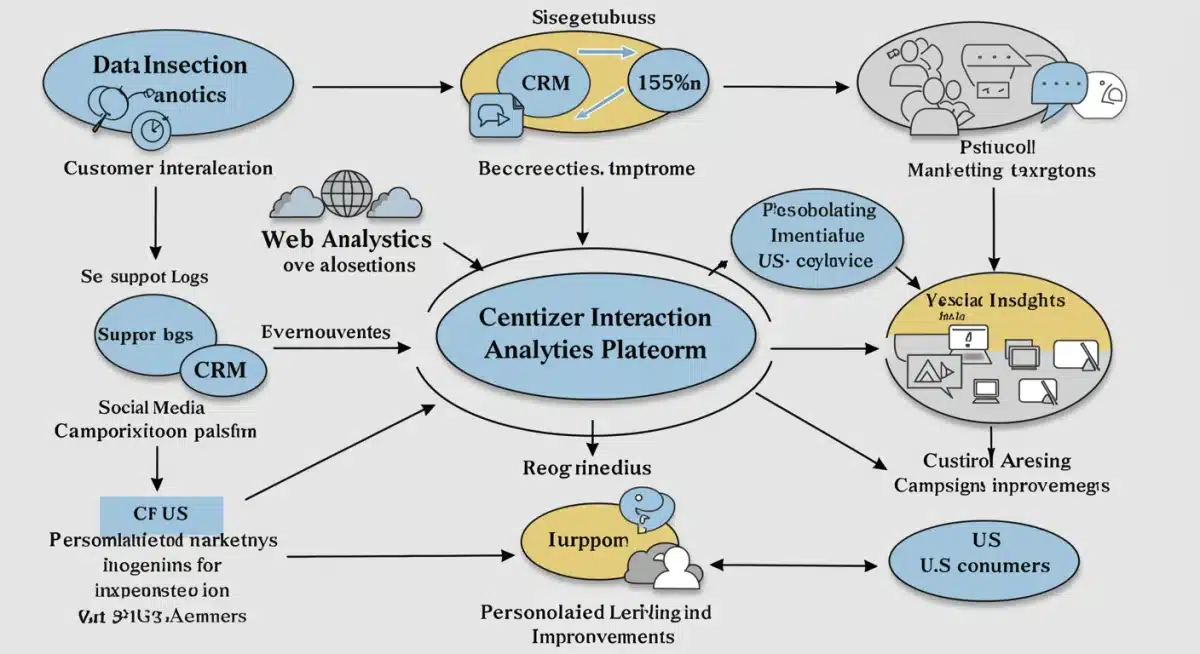
The first step is data consolidation. Customer data often resides in disparate systems: CRM, marketing automation platforms, website analytics, social media, and customer service logs. Integrating these sources into a unified data platform is critical. This single source of truth allows for a holistic view of the customer, enabling analysts to trace their path across various interactions seamlessly. Breaking down data silos is paramount for creating an accurate and actionable journey map.
Key data sources for mapping
A variety of data sources contribute to a rich journey map. Web analytics provide insights into online behavior, while CRM data details purchase history and customer service interactions. Social media listening tools reveal customer sentiment and brand perception. Combining these diverse datasets allows for a multi-dimensional understanding of the customer.
- Web analytics: Page views, time on site, conversion rates.
- CRM data: Purchase history, support tickets, demographic information.
- Social media: Mentions, sentiment, engagement.
- Transactional data: Purchase frequency, average order value, returns.
Once data is collected, advanced analytics techniques come into play. This includes segmenting customers based on their behavior, identifying common journey paths, and analyzing conversion and drop-off points. Visualization tools are essential for making complex data understandable, allowing stakeholders to easily grasp insights from the journey maps. The power of data analytics lies not just in collecting information, but in transforming it into clear, strategic guidance. This continuous cycle of data collection, analysis, and visualization ensures that journey maps remain dynamic and relevant.
Identifying critical touchpoints for retention
Identifying critical touchpoints within the customer journey is paramount for improving retention. These are the moments that significantly influence a customer’s decision to stay with a brand or churn. Data analytics plays a crucial role in pinpointing these moments, moving beyond intuition to evidence-based identification. Understanding where customers experience friction or delight allows brands to focus their efforts for maximum impact.
A critical touchpoint could be anything from the initial onboarding process to a customer service interaction or a renewal notification. By analyzing data such as customer satisfaction scores, time spent on certain pages, or the resolution speed of support tickets, brands can identify which interactions have the highest correlation with retention or churn. For instance, a high drop-off rate during a specific stage of a product setup indicates a critical friction point that needs immediate attention.
Analyzing friction points and moments of truth
Friction points are moments where the customer experiences difficulty, confusion, or dissatisfaction. These can lead to frustration and, ultimately, churn. Moments of truth, on the other hand, are interactions where a customer forms a strong opinion about a brand, either positive or negative. Identifying these requires a deep dive into qualitative and quantitative data.
- Onboarding bottlenecks: Where new users struggle to get started.
- Customer service interactions: Efficiency and empathy in problem-solving.
- Product usage patterns: Features that delight or frustrate users.

Data analytics allows brands to quantify the impact of these touchpoints. For example, by tracking customer sentiment after a support call or monitoring engagement with personalized content, companies can measure the effectiveness of their interventions. The insights gained from identifying these critical touchpoints enable brands to prioritize improvements, allocate resources efficiently, and design experiences that consistently lead to higher customer satisfaction and loyalty. This iterative process of identification and optimization is central to achieving a 10% increase in retention.
Personalization strategies for increased customer retention
Personalization is no longer a buzzword; it’s a fundamental expectation for customers in 2025. Leveraging insights from customer journey mapping and data analytics, US brands can craft highly individualized experiences that resonate deeply with their audience. This tailored approach fosters stronger emotional connections and significantly contributes to increased customer retention. Generic interactions simply won’t cut it in today’s competitive market.
The foundation of effective personalization lies in understanding individual customer preferences, behaviors, and needs at each touchpoint. Data analytics provides this granular understanding. For example, if a customer frequently browses a specific product category but hasn’t purchased, personalized recommendations or targeted offers can nudge them towards conversion. Similarly, recognizing a long-term customer’s loyalty allows for exclusive rewards or early access to new products, reinforcing their value to the brand.
Tailoring communications and offers
Personalized communication extends beyond just using a customer’s name. It involves delivering relevant messages through preferred channels at optimal times. This could mean sending a personalized email with product suggestions based on past purchases, or offering a discount on an item they abandoned in their cart. The key is to be helpful and timely, not intrusive.
- Segmented email campaigns: Content tailored to specific customer groups.
- Dynamic website content: Pages that adapt based on user behavior.
- In-app recommendations: Suggestions within mobile applications.
Beyond individual interactions, personalization can also extend to the overall customer experience. This might include customizing the onboarding process for different user segments or providing proactive support based on anticipated issues. The goal is to make every customer feel understood and valued, transforming a transactional relationship into a lasting partnership. By continuously refining personalization strategies based on ongoing data analysis, brands can cultivate deeper loyalty and drive that crucial 10% increase in retention. It’s about building a relationship, one personalized interaction at a time.
Measuring the impact: KPIs for retention growth
To truly understand the effectiveness of customer journey mapping and data analytics on retention, US brands must establish clear Key Performance Indicators (KPIs) and consistently measure their impact. Without robust measurement, it’s impossible to discern which strategies are working and where further optimization is needed. The objective is not just to implement new strategies, but to prove their value through quantifiable results.
The primary KPI for this initiative is, of course, customer retention rate. However, a comprehensive measurement strategy goes deeper. It involves tracking metrics that directly influence retention, such as customer lifetime value (CLV), churn rate, repeat purchase rate, and customer satisfaction (CSAT) scores. Monitoring these metrics over time provides a holistic view of the program’s success and helps identify areas for improvement.
Key retention metrics to track
Each KPI offers a unique perspective on customer loyalty and engagement. Analyzing them collectively provides a powerful diagnostic tool for assessing the health of customer relationships and the effectiveness of retention efforts. Combining these quantitative metrics with qualitative feedback offers a complete picture of customer sentiment and behavior.
- Customer retention rate: Percentage of customers retained over a period.
- Churn rate: Percentage of customers lost over a period.
- Customer lifetime value (CLV): Total revenue expected from a customer.
- Repeat purchase rate: Frequency of repeat purchases by customers.
- Net Promoter Score (NPS) / Customer Satisfaction (CSAT): Measures customer loyalty and satisfaction.
Advanced analytics tools can help correlate specific journey interventions with changes in these KPIs. For instance, A/B testing different personalized email campaigns can reveal which approach leads to a higher repeat purchase rate. By continuously tracking and analyzing these KPIs, brands can refine their customer journey strategies, optimize touchpoints, and ensure they are on track to achieve and even exceed their 10% retention growth target. This data-driven feedback loop is essential for sustained success in 2025 and beyond.
Overcoming challenges in data-driven journey mapping
While the benefits of data-driven customer journey mapping are clear, US brands often face significant challenges in its implementation. Overcoming these hurdles is crucial for unlocking the full potential of this strategic approach and achieving ambitious retention goals. These challenges typically revolve around data quality, integration, and the organizational mindset.
One of the most common challenges is data fragmentation. Customer data is often scattered across various departments and systems, making it difficult to create a unified customer view. Inconsistent data formats, missing information, and outdated records can severely hamper the accuracy and reliability of journey maps. Investing in robust data governance and integration platforms is essential to address this issue and ensure data integrity across the organization.
Addressing data quality and siloes
Poor data quality can lead to flawed insights and misguided strategies. Establishing clear data collection protocols, regular data audits, and employing data cleansing techniques are vital. Furthermore, breaking down departmental data silos requires a cultural shift towards data sharing and collaboration. This ensures that all teams have access to a consistent and comprehensive view of the customer.
- Data governance frameworks: Policies and procedures for data management.
- Integration platforms: Tools to connect disparate data sources.
- Employee training: Educating staff on data collection best practices.
Another significant challenge is the complexity of analyzing vast datasets and extracting meaningful insights. This often requires specialized skills in data science and analytics, which may not be readily available within every organization. Partnering with external experts or investing in internal training can bridge this skill gap. Finally, gaining organizational buy-in and fostering a data-driven culture is perhaps the most critical challenge. Without leadership support and cross-functional collaboration, even the most sophisticated data analytics initiatives can falter. By proactively addressing these challenges, brands can build a solid foundation for successful data-driven customer journey mapping, paving the way for a significant increase in customer retention.
| Key Point | Brief Description |
|---|---|
| Evolving Journeys | Customer paths are increasingly complex and multi-channel, requiring dynamic, data-driven mapping. |
| Data-Driven Mapping | Consolidating diverse data sources and using AI for accurate, actionable insights into customer behavior. |
| Critical Touchpoints | Identifying key interaction moments that significantly influence customer satisfaction and retention. |
| Personalization & KPIs | Tailoring experiences based on data and measuring impact with clear metrics like churn rate and CLV. |
Frequently asked questions about customer journey analytics
It’s the process of visualizing the entire customer experience with a brand, from initial contact to post-purchase, by leveraging comprehensive data from all touchpoints. This data-driven approach helps identify key interactions, pain points, and opportunities to enhance satisfaction and loyalty.
In 2025, customer journeys are highly complex and multi-channel. Data analytics provides the precision and depth needed to understand these intricate paths, moving beyond assumptions to deliver actionable insights. It allows for real-time adjustments and predictive capabilities, essential for competitive US brands.
By identifying critical touchpoints, brands can focus resources on optimizing moments that most influence customer satisfaction and loyalty. Addressing friction points and enhancing positive interactions directly reduces churn and builds stronger relationships, leading to higher retention rates.
Effective journey mapping utilizes a blend of data types, including web analytics (behavioral), CRM data (transactional, demographic), social media listening (sentiment), and customer service logs. Integrating these disparate sources provides a holistic view of the customer’s interactions and experiences.
Challenges include data fragmentation across systems, ensuring data quality and consistency, and the need for specialized analytical skills. Overcoming these requires robust data governance, integration tools, and fostering a data-driven culture within the organization to maximize impact.
Conclusion
As we navigate 2025, the imperative for US brands to strategically enhance customer retention has never been clearer. Customer journey mapping, empowered by sophisticated data analytics, offers a powerful roadmap for achieving this. By meticulously identifying and optimizing key touchpoints, personalizing interactions, and continuously measuring impact through relevant KPIs, brands can not only aim for but realistically achieve a 10% increase in customer retention. The journey ahead demands a proactive, data-centric approach to understanding and serving the evolving customer. Those who embrace this transformation will undoubtedly stand out in a crowded market, building lasting loyalty and sustainable growth.