AR in E-commerce: Boosting Purchase Intent by 10% in 2025

Augmented reality in e-commerce is poised to increase purchase intent by 10% in 2025 by offering highly personalized and immersive shopping experiences that bridge the gap between physical and digital retail.
The landscape of online retail is constantly evolving, with new technologies emerging to redefine how consumers interact with products. Among these innovations, augmented reality in e-commerce stands out as a powerful tool, projected to significantly enhance customer engagement and drive purchase intent. This isn’t just a futuristic concept; it’s a tangible shift that promises to reshape digital sales strategies by 2025, offering an immersive bridge between the digital and physical worlds.
The rise of augmented reality in consumer behavior
Augmented reality (AR) is rapidly moving from a niche technology to a mainstream expectation in e-commerce. Consumers, especially in the United States, are increasingly seeking more interactive and personalized shopping experiences that go beyond static images and descriptions. AR provides this by overlaying digital information onto the real world, allowing shoppers to visualize products in their own environments before making a purchase.
This shift in consumer behavior is driven by several factors, including the widespread adoption of smartphones capable of running sophisticated AR applications and a growing desire for confidence in online purchases. The ability to ‘try before you buy’ virtually eliminates many uncertainties, leading to higher satisfaction and fewer returns. As AR technology becomes more sophisticated and accessible, its integration into e-commerce platforms is becoming not just an advantage, but a necessity for competitive brands.
Enhanced product visualization and decision-making
One of the primary benefits of AR in e-commerce is its capacity to offer unparalleled product visualization. Instead of relying on imagination, customers can see how an item, whether it’s a piece of furniture, clothing, or even makeup, looks and fits in their personal space or on their person. This level of detail and realism significantly impacts their decision-making process.
- Realistic scaling: View furniture or decor items accurately sized in a room.
- Virtual try-on: Experiment with clothing, accessories, or cosmetics on oneself.
- 3D exploration: Interact with products from all angles, uncovering intricate details.
- Customization previews: Visualize personalized items before committing to a purchase.
The immediate feedback and tangible feel that AR provides help shoppers make more informed decisions, reducing the cognitive load associated with online shopping. This not only increases the likelihood of a purchase but also fosters a stronger emotional connection with the product and the brand.
In conclusion, the increasing penetration of augmented reality into the daily lives of consumers is setting the stage for its pivotal role in e-commerce. By offering a richer, more interactive shopping journey, AR is addressing key pain points of online retail and paving the way for a more confident and engaging purchasing experience, directly influencing purchase intent.
Bridging the gap: AR’s impact on purchase intent metrics
The promise of augmented reality in e-commerce is not just about novelty; it’s about measurable business outcomes, specifically an increase in purchase intent. Industry experts and early adopters are already seeing tangible results, which point towards a significant uplift, potentially reaching 10% by 2025. This metric is crucial for e-commerce businesses as it directly correlates with conversion rates and overall revenue growth.
The core of AR’s impact on purchase intent lies in its ability to reduce perceived risk and enhance perceived value. When a customer can virtually place a sofa in their living room and see that it perfectly matches their decor and fits the space, the uncertainty that often accompanies large online purchases diminishes dramatically. This confidence translates directly into a higher willingness to click ‘add to cart’.
Quantifiable benefits and case studies
Numerous studies and real-world implementations have begun to quantify the benefits of AR in e-commerce. Brands that have adopted AR features report notable improvements in key performance indicators (KPIs). These improvements extend beyond just purchase intent, touching on aspects like return rates and customer satisfaction.
- Reduced return rates: Customers make more informed choices, leading to fewer discrepancies between expectation and reality.
- Higher conversion rates: Enhanced visualization directly correlates with completed purchases.
- Increased engagement time: Shoppers spend more time interacting with products, deepening their connection.
- Improved brand perception: Companies utilizing AR are seen as innovative and customer-centric.
For instance, a leading furniture retailer reported a 10% increase in conversion rates for products viewed with AR. Similarly, a beauty brand saw a 20% uplift in sales for virtual try-on items. These examples underscore the profound and quantifiable impact AR has on the e-commerce ecosystem, transforming casual browsing into committed buying decisions.
The data clearly indicates that augmented reality is not merely a passing trend but a powerful tool capable of driving significant improvements in purchase intent. By providing a more complete and reassuring shopping journey, AR enables customers to make confident decisions, which is invaluable in the competitive world of online retail.
Technological advancements driving AR adoption
The rapid evolution of augmented reality technology is a primary catalyst for its increasing adoption in e-commerce. What was once confined to specialized hardware is now accessible through everyday devices, democratizing AR experiences for a vast consumer base. Innovations in hardware, software, and connectivity are making AR more seamless, realistic, and easier to integrate into existing e-commerce platforms.
Smartphones, with their increasingly powerful processors, high-resolution cameras, and advanced sensors, have become the primary vehicle for AR experiences. This ubiquity means that e-commerce businesses don’t need to wait for consumers to adopt new gadgets; they can leverage the technology already in their pockets. Furthermore, continuous improvements in AR development kits (SDKs) from tech giants like Apple (ARKit) and Google (ARCore) simplify the creation of sophisticated AR applications.
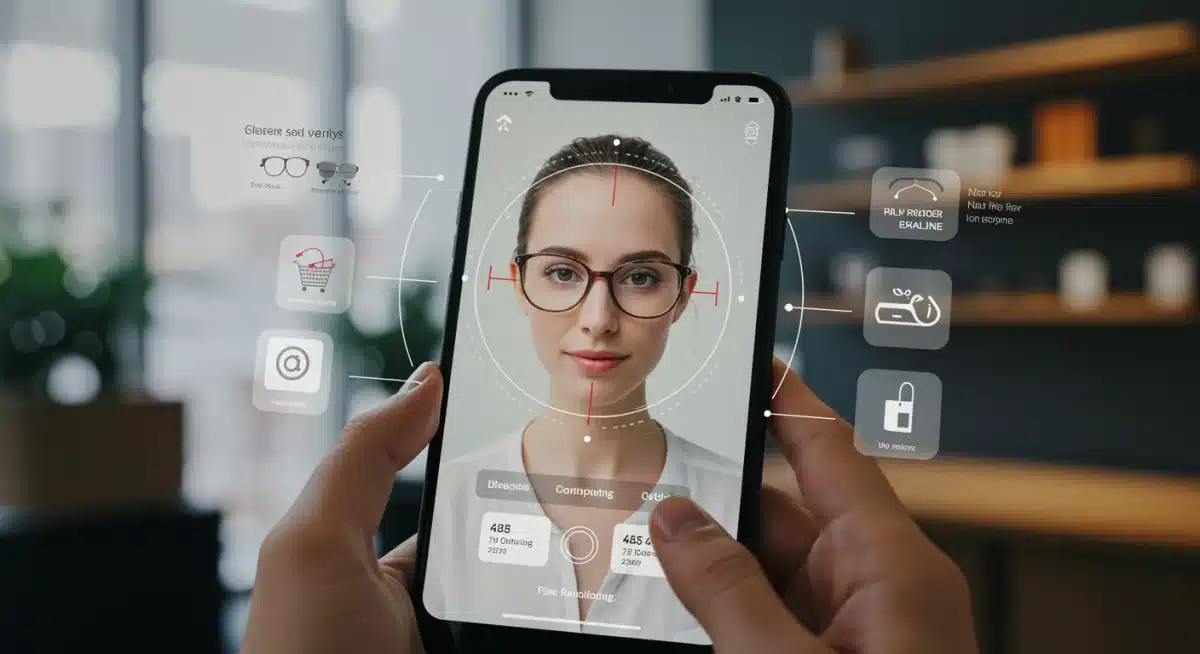
Key innovations enhancing AR experiences
Several technological breakthroughs are contributing to the richness and effectiveness of AR in e-commerce. These advancements address previous limitations, making AR more robust and user-friendly, thereby driving broader consumer acceptance and utilization.
- Improved object recognition: More accurate detection and tracking of real-world surfaces and objects.
- Realistic rendering: Enhanced graphics and lighting capabilities make virtual objects appear more lifelike.
- Cloud computing integration: Offloading heavy processing to the cloud for smoother, faster AR experiences.
- 5G connectivity: Low latency and high bandwidth enable real-time, interactive AR without delays.
These innovations collectively create a more compelling and reliable AR experience, which is crucial for maintaining user engagement. As the technology continues to mature, we can expect even more sophisticated and intuitive AR applications that further blur the lines between the digital and physical, making online shopping an even more immersive activity.
In summary, the ongoing advancements in AR technology, particularly in mobile computing and cloud infrastructure, are making it increasingly viable and impactful for e-commerce. These technological leaps are not only improving the quality of AR experiences but also expanding their reach, solidifying AR’s role as a cornerstone of future online retail.
Implementation strategies for e-commerce businesses
For e-commerce businesses looking to capitalize on the augmented reality trend and boost purchase intent, strategic implementation is key. Simply integrating an AR feature without a clear purpose or user-centric design will likely yield suboptimal results. A thoughtful approach involves understanding target audience needs, choosing the right AR solutions, and seamlessly integrating them into the existing customer journey.
The first step is often to identify specific pain points in the current online shopping experience that AR can effectively address. For instance, if customers frequently return furniture due to size or fit issues, an AR ‘placement’ tool becomes invaluable. If apparel returns are high due to fit or style concerns, a virtual try-on solution would be more appropriate. Tailoring the AR experience to solve a genuine customer problem is paramount for success.
Best practices for integrating AR into your platform
Successful AR integration requires more than just technical deployment; it demands a holistic strategy that considers user experience, marketing, and analytics. Businesses must ensure that the AR feature is easily discoverable, intuitive to use, and adds genuine value to the shopping process.
- User-friendly interface: Design AR features that are simple and straightforward to activate and navigate.
- High-quality 3D models: Invest in accurate and visually appealing 3D representations of products.
- Clear calls to action: Guide users on how to use the AR feature and how it benefits them.
- Cross-platform compatibility: Ensure AR experiences are accessible across various devices and operating systems.
- Performance optimization: Guarantee smooth and responsive AR functionality to prevent frustration.
Furthermore, promoting AR capabilities through marketing channels and educating customers on how to use them can significantly increase adoption rates. Collecting data on AR usage and its impact on conversion rates and return rates will also be crucial for continuous improvement and demonstrating ROI.
The effective implementation of augmented reality in e-commerce is a multi-faceted endeavor that goes beyond mere technology. By focusing on user needs, leveraging best practices, and continuously optimizing the experience, businesses can unlock the full potential of AR to drive purchase intent and foster stronger customer relationships.
Measuring success: KPIs for AR in e-commerce
To truly understand the value that augmented reality brings to an e-commerce platform, businesses must establish clear key performance indicators (KPIs) and consistently monitor them. Simply implementing AR isn’t enough; proving its effectiveness through data-driven insights is essential for justifying investment and demonstrating its contribution to business objectives. The goal is to track how AR influences customer behavior throughout the purchase funnel.
Effective measurement goes beyond just tracking clicks. It involves analyzing the entire customer journey, from initial engagement with an AR feature to post-purchase satisfaction. This holistic view provides a comprehensive understanding of AR’s impact on purchase intent, conversion rates, and ultimately, customer loyalty. Without robust measurement, the true potential and areas for improvement of AR initiatives remain obscured.
Essential metrics for evaluating AR performance
A range of metrics can be employed to gauge the success of AR integrations in e-commerce. These KPIs offer insights into user engagement, conversion efficiency, and overall business impact, providing a clear picture of AR’s return on investment.
- AR engagement rate: Percentage of users who interact with an AR feature.
- Conversion rate uplift: Increase in purchase conversions for products viewed with AR compared to those without.
- Average session duration: Time spent by users interacting with AR features.
- Return rate reduction: Decrease in product returns for items experienced through AR.
- Customer satisfaction scores (CSAT): Feedback related to the AR experience and its impact on buying confidence.
- Add-to-cart rate for AR-viewed products: Higher rates indicate stronger purchase intent.
By regularly analyzing these metrics, businesses can gain valuable insights into what’s working well and where adjustments are needed. This iterative process of implementation, measurement, and optimization is crucial for maximizing the benefits of augmented reality and ensuring it consistently contributes to increasing purchase intent.
In conclusion, a rigorous approach to measuring the performance of AR in e-commerce is indispensable. By focusing on a comprehensive set of KPIs that span engagement, conversion, and post-purchase behavior, businesses can accurately assess the impact of AR and refine their strategies to achieve significant uplifts in purchase intent and overall business success.
The future outlook: AR and personalized shopping experiences
The journey of augmented reality in e-commerce is far from over; in fact, it’s just beginning to unlock its full potential. The future promises even more sophisticated and integrated AR experiences that will further personalize the shopping journey, making it more intuitive, engaging, and tailored to individual consumer preferences. The vision for 2025 and beyond sees AR not just as a feature, but as an intrinsic part of the digital retail fabric, driving unparalleled levels of purchase intent.
As AI and machine learning capabilities continue to advance, their synergy with AR will create truly intelligent shopping assistants. Imagine AR experiences that not only show you how a product looks but also recommend complementary items based on your existing decor, fashion style, or past purchases. This level of personalization will transform online shopping from a transactional activity into a highly curated and delightful experience.
Emerging trends and technologies in AR e-commerce
Several exciting trends are on the horizon, poised to further enhance the capabilities of augmented reality in e-commerce. These innovations will address current limitations and open up new avenues for immersive and personalized shopping experiences, solidifying AR’s role in boosting purchase intent.
- Web-based AR (WebAR): Eliminating the need for app downloads, making AR more accessible directly through web browsers.
- Persistent AR experiences: Virtual objects remaining in place even after closing and reopening an AR application.
- Multiplayer AR shopping: Allowing friends or family to shop together in a shared virtual space.
- Haptic feedback integration: Adding tactile sensations to virtual interactions for a more realistic feel.
- AI-powered recommendations: Leveraging AI to offer hyper-personalized product suggestions within AR environments.
These advancements suggest a future where AR is not just about visualization but about creating a truly interactive and emotionally resonant shopping environment. The goal is to replicate and even surpass the benefits of physical retail, offering convenience, choice, and a deep sense of confidence in every purchase.
Ultimately, the future of augmented reality in e-commerce is bright, promising a landscape where personalized, immersive, and highly engaging shopping experiences are the norm. These innovations will continue to drive purchase intent upwards, making AR an indispensable tool for any forward-thinking e-commerce business aiming for success in 2025 and beyond.
| Key Aspect | Description |
|---|---|
| Purchase Intent Boost | Projected 10% increase by 2025 due to enhanced visualization. |
| Consumer Confidence | AR reduces uncertainty, leading to more informed buying decisions. |
| Technological Drivers | Mobile device power, WebAR, and AI integration fuel adoption. |
| Strategic Implementation | Focus on user experience, quality 3D models, and clear CTAs. |
Frequently asked questions about AR in e-commerce
Augmented reality increases purchase intent by allowing customers to visualize products in their real-world environment, reducing uncertainty and enhancing confidence in their buying decisions. This immersive experience bridges the gap between online browsing and physical interaction, making the purchase feel more tangible and less risky.
Products where visual fit, size, or appearance are crucial benefit significantly. This includes furniture, home decor, clothing, accessories, cosmetics, and even complex machinery. AR helps customers confirm aesthetic compatibility and functional suitability before committing to a purchase, minimizing post-purchase disappointment.
Key challenges include the cost of creating high-quality 3D models, ensuring seamless integration with existing platforms, and educating customers on how to use AR features. Additionally, maintaining consistent performance across various devices and ensuring data privacy are ongoing considerations that businesses must address for successful implementation.
Yes, AR can significantly reduce product return rates. By providing a more accurate visualization of products in context, customers are better able to assess fit, size, and appearance before purchase. This leads to fewer instances where the received product does not meet expectations, thereby decreasing returns and improving customer satisfaction.
AI will play a crucial role by enabling hyper-personalization within AR experiences. It will power intelligent product recommendations based on user preferences, contextual awareness (e.g., suggesting items that match existing decor), and dynamic adjustments to AR interfaces. This synergy will make AR shopping even more intuitive and tailored to individual needs.
Conclusion
The trajectory of augmented reality in e-commerce is undeniably set towards a future of elevated customer engagement and significantly increased purchase intent. As we approach 2025, the projected 10% boost in purchase intent is not merely an optimistic forecast but a reflection of AR’s proven ability to transform the online shopping experience. By bridging the sensory gap inherent in digital transactions, AR empowers consumers with unprecedented confidence, allowing them to visualize products in their own environments and make informed decisions. This technological evolution, supported by continuous advancements and strategic implementation, positions AR as an indispensable tool for e-commerce businesses striving for sustained growth and a superior customer journey in the competitive digital landscape.